I use AI across research, product, and engineering to investigate unfamiliar problems, build what is required, and test the result against evidence. That evidence may come from solvers, real data, primary sources, automated checks, customer acceptance, or people who know the field.
I take on consulting engagements through diagnostics, fixed-scope projects, and retainers.
Selected work
Built. Tested. Put to work.
From fixing a client’s simulation to building an engineering-AI workspace.
Product walkthrough · 2 min 44 sec · No audio
01 / Product build · Private alpha
PhyStudio
An AI workspace with engineering checks built in.
I built a workspace to explore designs, inspect CAD, compare trade-offs, and send candidates for solver verification and human review.
AI helps find candidates. The evidence determines what can be trusted.
Inside the project
The workflow connects CAD and dataset intake, design exploration, applicability checks, verification queues, and an audit trail of revisions and decisions.
This is a private-alpha product demonstration, not a claim of production deployment or certified designs. The demo has no narration; its on-screen guided steps explain the workflow.
02 / Independent research · Open evidence
When can a physics-AI model be trusted?
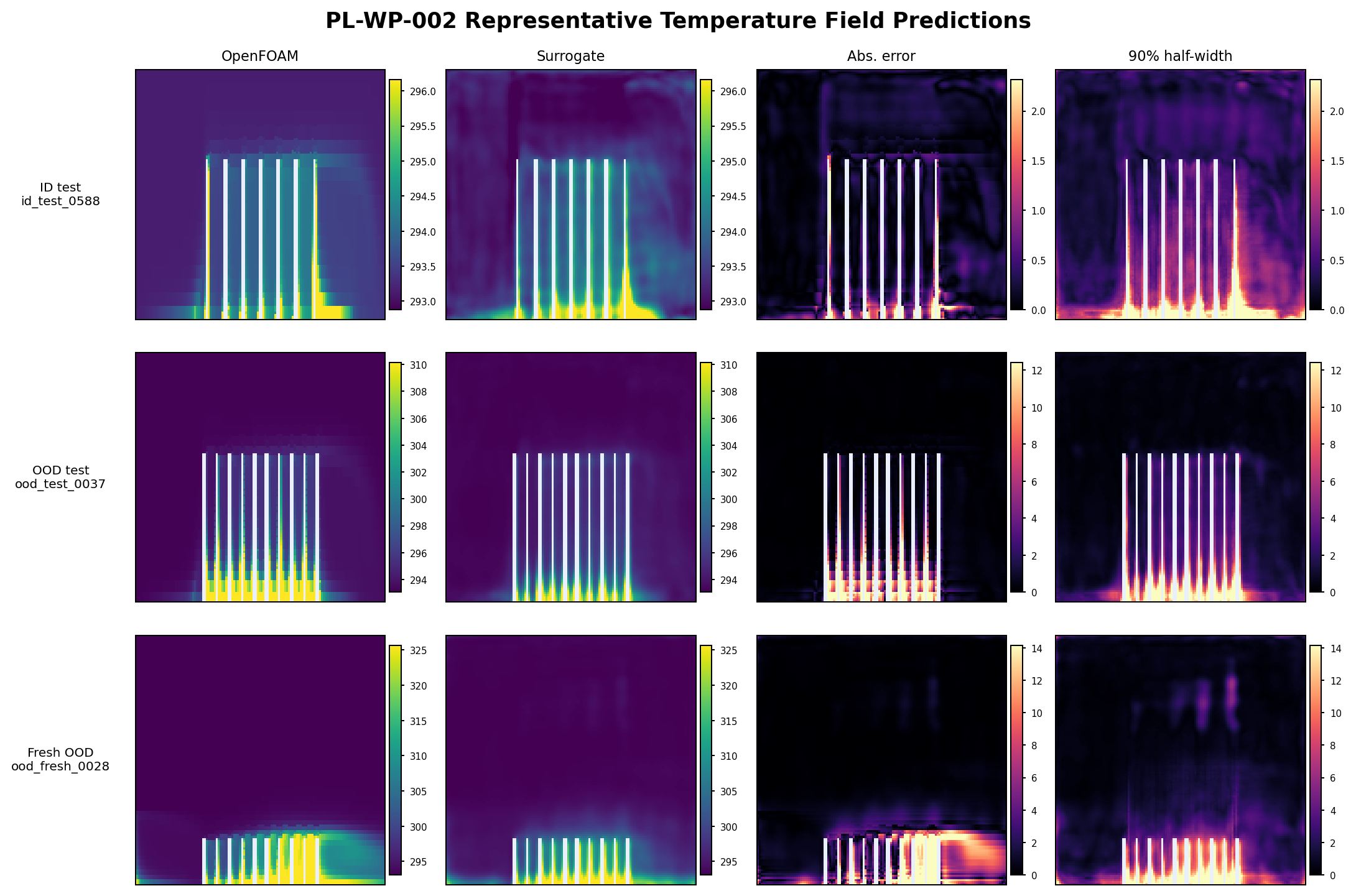
I tested AI-predicted temperature and velocity fields against OpenFOAM, measured uncertainty, and checked where the model should hand back to the solver.
Solver → prediction → error → uncertainty. Select the figure to inspect it.
848solver-qualified cases
23automated tests
A reproducible way to test an AI model’s limits—not just show its best prediction.
What the results showed
Uncertainty was calibrated within the tested operating range. Errors increased outside it, and uncertainty alone was not a reliable detector of every failure. Explicit operating-range checks and solver fallback remain essential.
A bounded research benchmark, not a replacement for OpenFOAM or a production coolant model.
Get the simulation working. Move the project forward.
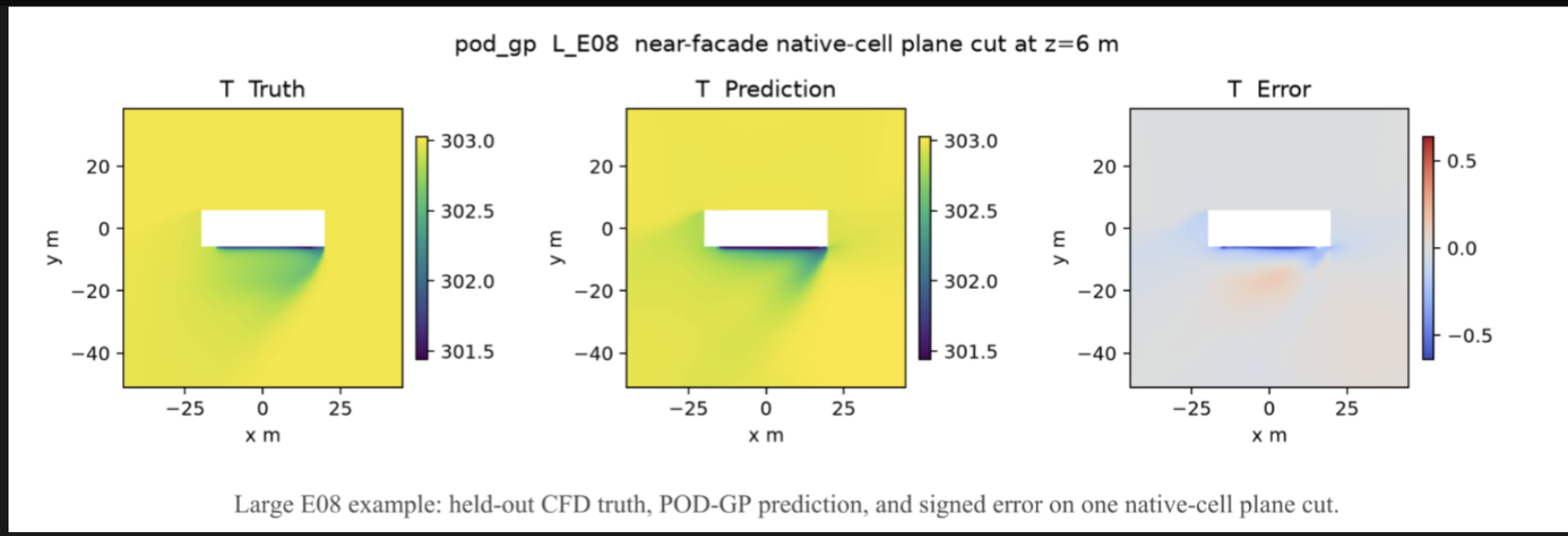
The client needed reliable results for its next phase. I kept the existing system, traced a humidity calculation issue, corrected it, and checked the results with the team.
Held-out façade case · CFD truth, POD-GP prediction, and signed temperature error.
The result
A usable baseline. A paid follow-on phase.
The wider work included a reproducible 48-case OpenFOAM campaign and checked temperature, humidity, and source-field outputs for downstream machine learning.
What I worked on
Reproducing the baseline, checking inputs and solver setup, investigating the moisture-to-vapour-pressure conversion, and automating case preparation, convergence checks, and repeatable exports.
The priority was to establish results the team could use before expanding the development scope.
“We’re happy with the progress, and identifying the code bug and the input/setup issue was particularly useful. The additional checks you carried out on the façade implementation were also helpful.”
Dr. Kostas LyrasScientific Adviser · MultiFluidX · Researcher · King’s College London
“Thanks to Aditya Tiwari, who has been developing this solver-validated approach as an independent practice, for his work on this.”
Dr. Andrew TweedieCo-Founder and Co-CTO · Quanscient · Former Co-Founder · OnScale
“Your experience is exactly what we need for this phase. Thank you again for your excellent presentation.”
EBDr. Eberhard BaischThermal Research Scientist
Simulation reliability · AI for science
Consulting
Get a stuck simulation moving, build a reliable baseline, or bring in ongoing support. CFD, multiphysics, and physics AI—checked against physics and evidence.
Diagnostic
Fee range · USD$500–1,500
Investigate one stuck case. Get written findings, a short readout, and clear next steps.
Includes implementation and delivery of the agreed scope, typically what follows a Diagnostic. Deliverables may include an audited baseline, a fix, and a validated study or ML-ready pack.
Retainer
From · USD per month$6,000+
Ongoing support for simulation reliability and physics AI, with agreed priorities.